What Your Executives Aren’t Telling You About Talent (But Told Us)

Post content
By: Marc Effron
Talent Strategy Group
“We want to hold our leaders accountable to develop talent, but our execs won’t back us up.”
“We think we should be transparent about potential but we’d never get the senior team to agree.”
“A few high performers still get away with bad behaviors because our top leaders care more about results.”
We hear these and similar sentiments from HR leaders worldwide. They would do something to elevate performance, better emphasize behaviors, drive accountability or increase transparency, but… their top team isn’t interested. We respond politely, but directly – you’re wrong. In fact, across more than 100 client engagements asking 20+ questions in each, we have never once heard executives say the status quo is fine.
That confidence comes from data, not hubris. Thousands of executives have completed our Talent Philosophy survey during consulting engagements and told us how those issues are managed today and how they want them managed going forward. In that data, over the past 15 years, they consistently lean towards the positions that most HR leaders would advocate for.
What is Talent Philosophy and why does it matter?
A Talent Philosophy is the executive team’s preference for how to manage talent to achieve the business strategy. We created the approach 15 years ago to help executive teams elevate performance through better talent management.
A Talent Philosophy is the answer to business-driving questions like:
- What are the consequences of being a higher or lower performer in our company?
- To what extent do behaviors influence pay and promotion?
- How transparent are we with employees about their performance, behaviors and potential to advance?
and questions relating to accountability, development, differentiation and other select topics.
A unified talent philosophy, applied consistently across the business, ensures that everyone is being managed in the optimal way to achieve the strategy. Without an executive talent philosophy, every individual manager applies their personal talent philosophy – good, bad or tragic. How each employee is managed becomes a roll of the dice.
What Your Executives Want (according to them)
Our article title states that your executives aren’t telling you what they want from talent. We say that because our data shows a strong, consistent gap between what top executives say they want and how they assess their company’s current state. In short, they want talent managed differently than it is being managed today in your organization.
Why aren’t they telling you this? Well, have you asked? We find that the questions we pose and discuss in the talent philosophy process have never been brought up in a structured way and/or tied directly to strategy execution.
Or, if any topic has been raised it’s been HR pushing a point of view to executives rather than asking executives for theirs. A talent philosophy is their point of view about how to manage talent, not HR’s.
Here’s what executives say they want: more performance, more behavior-driven consequences, more accountability, more transparency, and more differentiation – the five things below, in order.
Overall: More rigor and discipline across every talent process and outcome.
Whether it’s holding leaders accountable for creating succession plans, considering behaviors in compensation, making more stretch assignment or any other talent practice, they want it done more and done more consistently. There is not a single question across the 20+ asked where executives indicated they were satisfied with the current level of that practice.
The largest changes they want to see are in how accountable managers are to develop successors and to coach talent on a regular basis. Executives wanted these behaviors moved from “Sometimes” conducted today to “Always” conducted in the future.
In our key talent philosophy categories, they said they want:
1. Higher performance overall and less tolerance for low performance
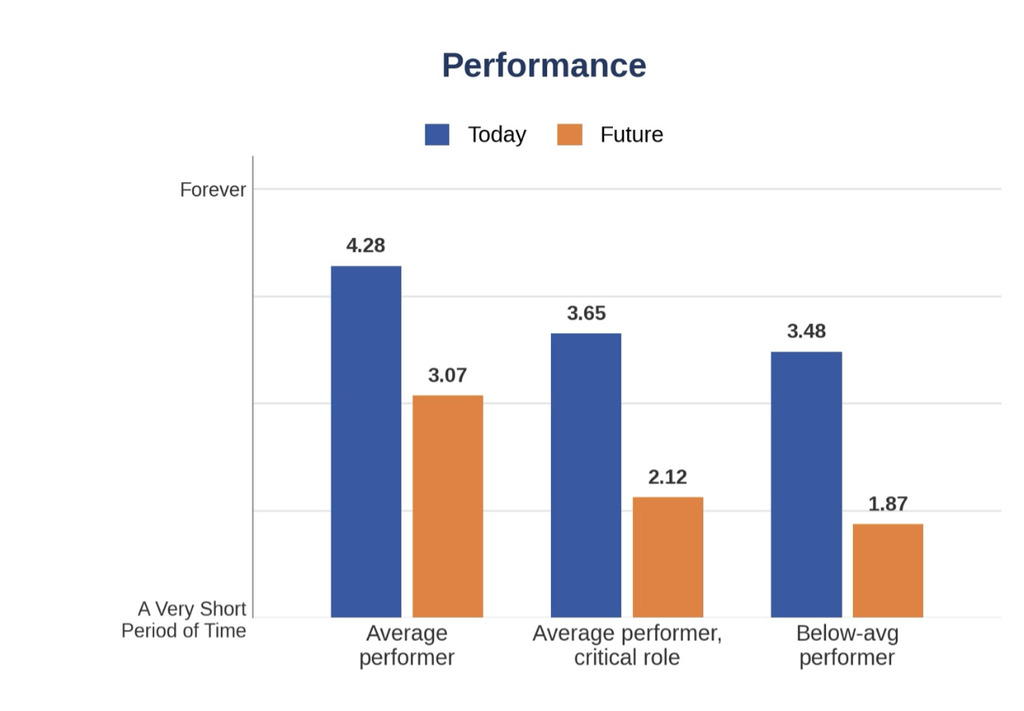
Perhaps most surprising to HR; across every performance category we ask about, executives said to turn the dial up. They want to see the performance bar increase each year on what defines average performance. They want much faster action taken on slightly below average performers and have little desire for average performance in a critical role. These were near universal conclusions, with no company – and exceptionally few individual executives – wanting anything other than a significant change in these, and other performance areas.
Practical implications: Higher performance comes from great goals, great coaching and high quality managers who elevate the performance of their team. When executives demand the shifts shown above, our most powerful levers are improving goal cascades, goal quality and coaching quality and elevating managers skills to set and achieve high standards through their teams.
2. Behaviors should have more impact, especially on career progress
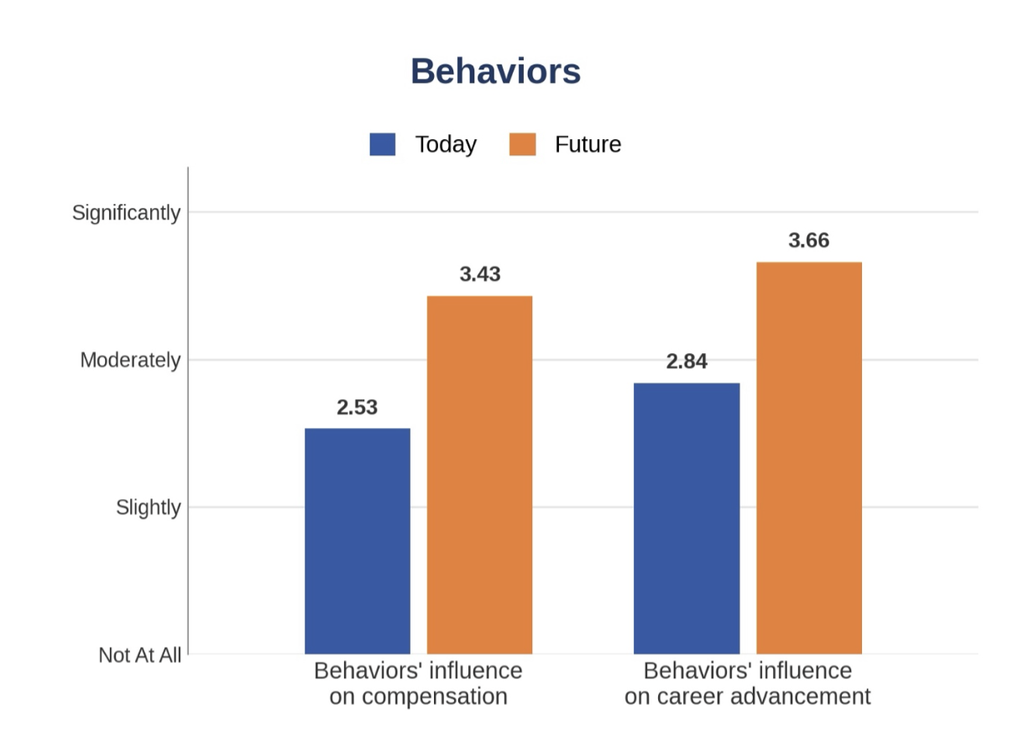
Two key areas we test in our talent philosophy work is how much behaviors should influence compensation and career advancement. Executives want to see a greater impact of behaviors on both, with career advancement being influenced slightly more. The message we hear in our client discussions is that imperfect demonstration of desired behaviors may be acceptable at one level, but you won’t be promoted to the next level unless they improve.
In my favorite question, we ask how much latitude there should be for high performers with less than ideal behaviors. Executives always want that dial turned down, but never to zero. There is still “behavior credit” given for outsized delivery of results.
Practical implications: The first step is to identify which behaviors matter. We’ve written extensively about this and applied that thinking at our clients through building Success Models. Then, test how consequential they are in performance management and talent reviews.
In performance management, are they a clear percentage weight to calculate with performance or do you have a vague statement like “performance and behaviors are equally important?” If there is a clear weight, does anyone ever get less than “full credit” for their behaviors? In most companies, the behavior portion is never differentiated.
In talent reviews, do you ask as part of the potential discussion, “Do we think that Susie can strongly demonstrate our Company Behaviors at the next level?” If behaviors matter, the ability to demonstrate them a level above should be a hard screen in promotion debates.
3. Hold managers accountable for team quality and depth
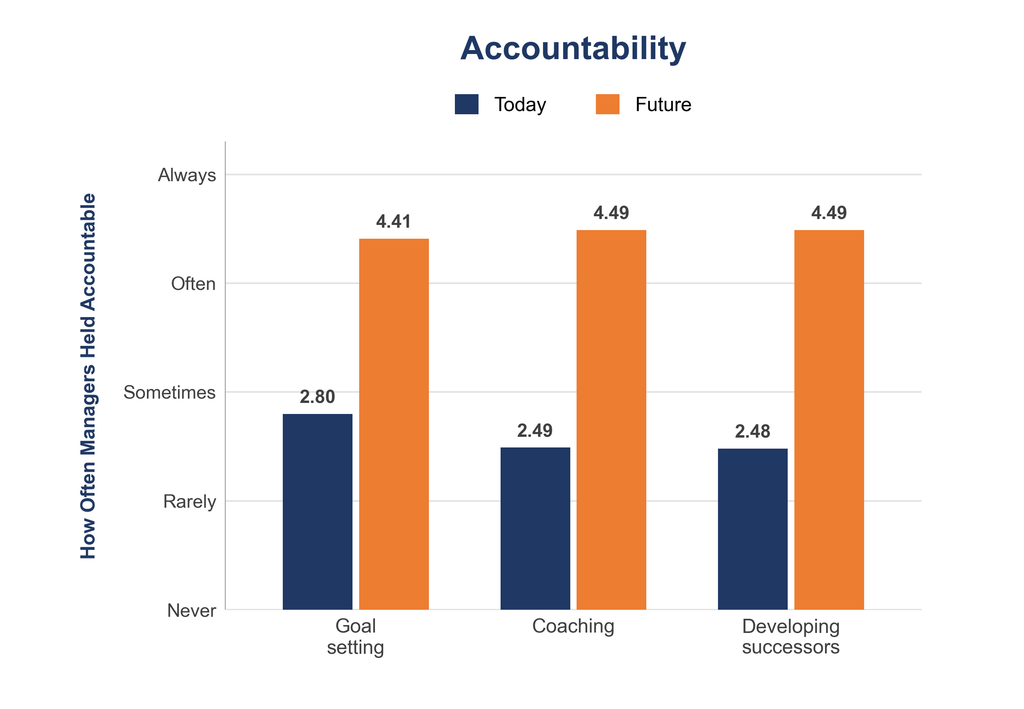
We asked executives a variety of questions about who should be accountable for what, and three key areas where they want managers to do more is goal setting, coaching and developing successors.
Their desired state is that people managers always engage in the activity. Now, we don’t define accountability in our surveys, so we don’t know what consequence they want attached to that accountability. But, the shift is the largest across all the topic areas we survey.
Practical Implications: We find lack of accountability is the single largest reason that desired talent actions don’t get done in organizations. There are no positive or negative consequences for people managers in most organizations for the quality of their team’s goals, the quality or frequency of their coaching or the accuracy of their succession choices.
So, step one is to determine for which of those activities you want there to be meaningful upside or downside consequences. Our article The Accountability Ladder, offers an array of increasingly impactful consequences. We always recommend that you use the least amount of accountability necessary to get the largest number of managers to comply.
A few of our favorite levers: Manager of manager review of goals, employee evaluation of feedback/coaching conversation quality and % placement rate from succession charts.
4. Be more transparent with employees about their career potential
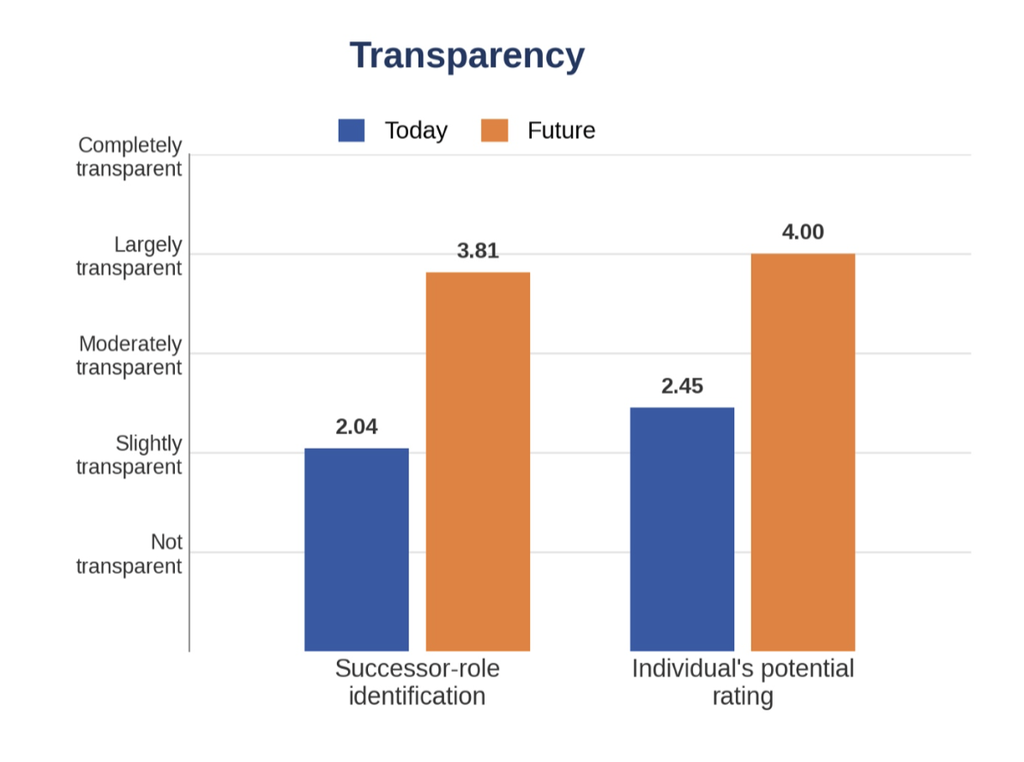
Perhaps most surprising to many HR leaders is how much their executives want to increase transparency with team members about key talent outcomes. While few executive teams want their companies to be 100% transparent about potential ratings, succession status, and pay level discussions, they want far greater transparency in each of those areas.
For the two items above – based both on the data and our discussions with them – executives want potential successors to know they are being considered and everyone to know their potential for promotion. The more nuanced version is that the succession conversation is a balanced one that stresses the contingent nature of the opportunity – that multiple hurdles lay ahead and even then, the role isn’t promised.
On potential, we hear strong desire for transparency with high potentials and still strong support for transparency with others.
Practical Implications: The practical challenge we find in most organizations is that they have not thought through the “prize in every box” or how to communicate the “deal” for being a high performer, average performer or any other category except for high potential. Read our article “A Prize in Every Box” and create your Talent Investment Grid. Train managers how to use this to create and communicate the right total reward package to every employee.
We sometimes hear HR resist greater transparency out of fear that managers will communicate poorly. Easy solution – train them. They’ll never get better until they start having these conversations so set a start date, train those you’re worried about and implement what your executives want.
5. Higher performance and higher potential should get more total investment
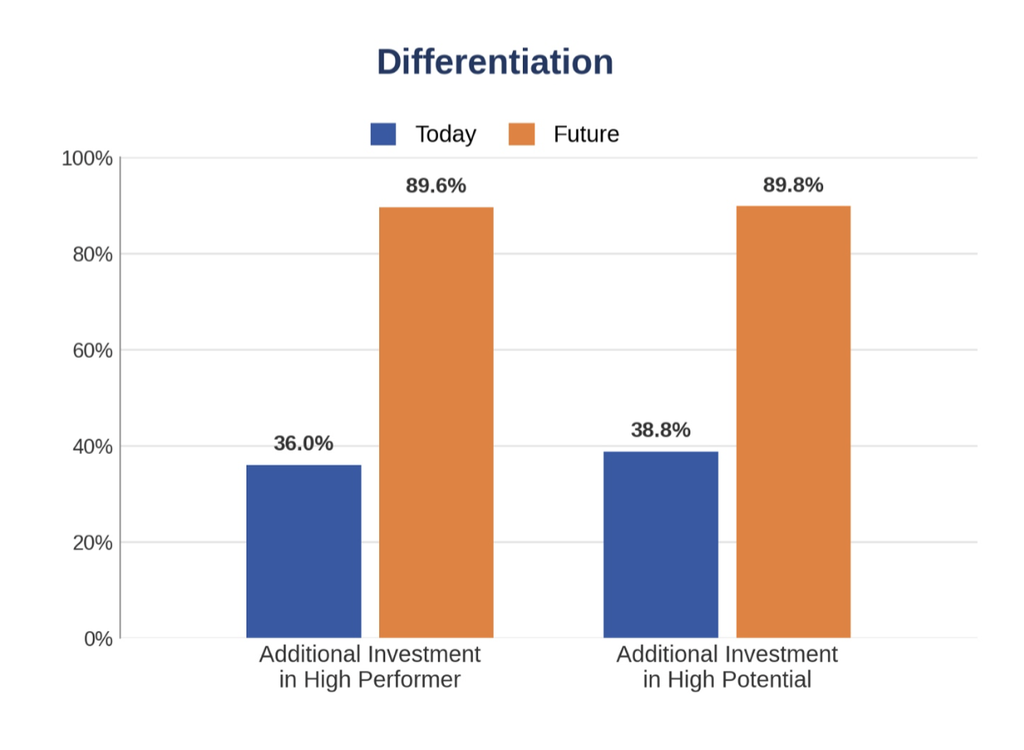
Executives want a significantly more aggressive stance on how they differentiate their investment in talent. The chart above is about the additional developmental investment they want to make in high performers and high potentials. Responses vary by company, with some wanting additional investments of 120% – 140%.
Practical Implications: The Talent Investment Grid we mention above is a great way to make this investment feel more concrete. Answer the question: Of all the ways we can invest in an employee – from projects to exposure to education to rewards – how do we want to allocate those finite resources across performance and potential?
And recognize the easy (but potentially unpleasant) math involved in giving an additional investment to high performers and high potentials. Since the rewards pie doesn’t expand, giving more pie to some means less pie for others. You need to be transparent about that and be able to explain why your investments are fair at all levels.
Where we are
The trends are compelling and consistent. Your executives want you in HR to create talent management and reward practices that better align with the company strategy. Practices that elevate performance. Practices that ensure great behaviors. Practices that drive higher accountability and more transparency.
Their responsibility, as we reinforce with them in our engagements, is to hold their team members accountable to manage this way. There cannot be any daylight between their words and their (and their team’s) deeds.
The consequence is an organization with a stronger, more unified culture, where every performance lever is perfectly aligned to support the strategy.
The trends we present in this article are powerful. But they aren’t your data. You still need to ask your executives the one question that starts the talent philosophy discussion: What’s the best way to manage our talent to achieve our strategy?