Reframing Talent in the Non-Profit Sector: A Smarter, Simpler Approach
Post content
By: Marc Effron
Talent Strategy Group
Manuela Morelli
Talentum Consulting
What Does Talent Mean to You?
Picture this scene:
A group of people sits around a light wood table in a nonprofit’s conference room.
An HR partner is holding a competency map, a programme director with rolled-up sleeves, a project manager checking their phone, and an executive director staring at the ceiling, deep in thought.
Written in bold on a whiteboard: “What is Talent?” Everyone starts to answer:
- “The person who delivered results last year.”
- “Someone who cares deeply.”
- “A rising star, ready for more.”
- “The quiet one who holds everything together behind the scenes.”
None of them is wrong. But none of them says the same thing.
And that’s where the challenge begins. Talent is everywhere. But ask five leaders what it means, and you’ll get five different answers.
When Good Intentions Aren’t Enough
In the non-profit sector, the terms talent and potential are often vague and inconsistently used. As HR leaders, executives, and managers, many of us have experienced the confusion firsthand: we care deeply about our people, but when asked what “talent” really means, we struggle to align on a definition.
Consider this: in Marc Effron’s article “Reaching for Stars: What You Need to Know About Exceptional Talent,” he defines talent as the characteristic of exceptionally capable individuals—those who sit above the intersection of high performers and high potentials.
Sounds clear enough. But does it apply in your organization? Can you name such individuals? And if so, can your systems promote, retain, and reward them?
Unfortunately, in non-profit and international organizations—whether governmental (often political) or non-governmental (often humanitarian)—the talent systems are rarely designed for this kind of clarity or impact.
What’s Broken?
- Promotions don’t reward excellence on the spot—“stars” must apply for roles like anyone else.
- Performance systems are weak or absent, and compensation is rarely linked to results.
- Managerial feedback is often lacking or misused. Underperformance is sometimes “solved” by shifting responsibilities rather than addressing root causes.
- Hiring is based on job descriptions, not future capability. Past achievements rather than future potential. And there’s little alignment on what defines great talent.
- Talent reviews, when they exist, are often political or purely administrative, with little strategic follow-through. Talent rosters rather than reviews are the actual process whereby “capable” professionals are placed on a list of suitable candidates for certain roles — without any succession planning or guarantee that they will actually take these roles.
This Is Where Change Starts
We understand why things are the way they are—legacy systems, representational constraints, and political sensitivities. But it’s time for a shift. As the saying goes, “What got you here won’t get you there.” Or, in the words of David Bowie: “Tomorrow belongs to those who can hear it coming.”
We propose a scientific, simple, and actionable approach to redefine how organizations define, detect, and develop talent—grounded in evidence and structured for implementation.
The Core Concepts
Let’s begin by clarifying the difference between talent and potential:
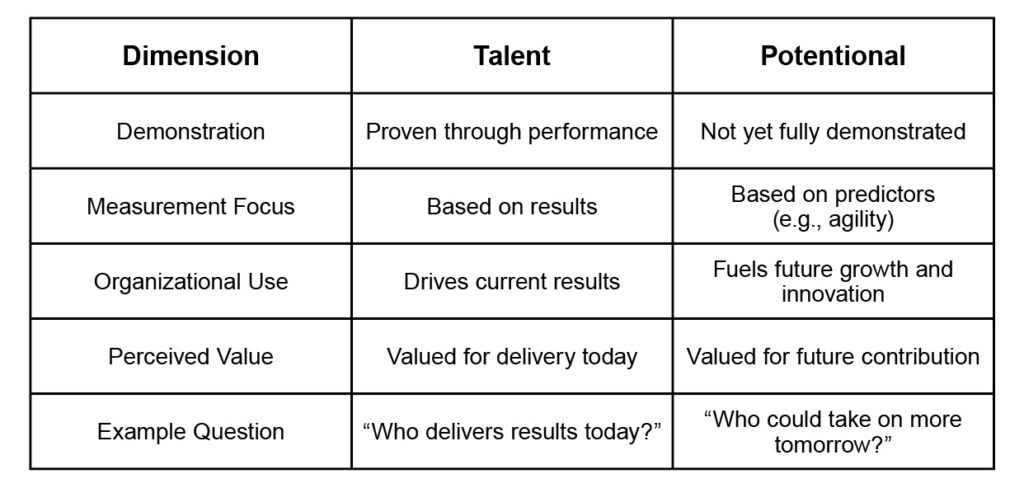
In Europe, “talent” is often equated with “high potential”; in the US, it may mean “employees” more broadly. This confusion reflects a bigger issue: we often lack a shared, strategic definition.
What We Propose: A Clear and Sustainable Shift
A Practical Talent Design in Seven Moves
Talent transformation doesn’t have to be abstract or overwhelming. In fact, it works best when it’s simple, grounded, and tied to real organizational life. Here’s how we help make it real:
- Define Talent by Role. Forget the generic labels. Ask yourself: “What differentiates the best person in this role?” and identify those 3–5 capabilities or behaviors for each critical role. For a programme manager, it might be “builds trust fast with all constituencies,” “stays focused on the vital few objectives,” or “leads calmly through chaos.” Make them specific. Make them useful. Then use them.
- Clarify What Potential Really Means. We often confuse potential with great performance. But high performance in one role doesn’t predict high performance in a larger or more complex role. Look for the individual indicators of upward potential proven by science — like learning agility, the ability to build relationships and influence, personal drive to do more, or a stretch mindset.
- Structure the Process. No more talent discussions over coffee or in whispers. Make it official—and useful. Use structured Talent Reviews (yes, with forms and prep!) where leaders assess both performance and potential. Then bring it together in a Talent Canvas: a simple visual map of who’s ready for what, and where the gaps are.
- Measure What Matters. Don’t let intuition drive your people strategy. Create a Potential Index—a tool that combines key traits (like agility, drive, and collaboration) with past performance. It’s not about scoring people like robots—it’s about having better, fairer conversations.
- Plot the Matrix. A classic move—but still powerful. Use a simple 2×2 Talent–Performance Matrix to see where your team stands. Who are your rising stars? Who’s stuck? Where do you need to coach, challenge, or maybe rethink a role? According to the Talent Strategy Group’s 2025 Potential Report, 82% of organizations use some type of matrix tool to chart their teams.
- Recruit for the Future. Don’t hire just to fill today’s job. Hire for what the organization is becoming. Can you define the four capabilities that will differentiate success in your organization three to four years from now? Identifies those so you can shift the recruiting conversation from “Who’s done this before?” to “Who could thrive here tomorrow?”
- Align on your Talent Philosophy. This is your compass. Agree (as an organization) on what talent means, how people grow, and how decisions are made. A Talent Philosophy is your leadership’s point of view on the best way to manage people to achieve your mission. Ask them: “Do we reward stretch? Do we believe potential is fixed or can grow?” The answers should shape your talent systems—not the other way around.
From Design to Action: Your 4-Step Action Plan
So—you’ve got the seven moves. You’ve got the mindset. Now what?
The truth is, transforming talent practices doesn’t require a revolution. But it does require focus, consistency… and a bit of courage. You don’t need to fix everything at once. You just need to start.
Let’s break it down into four clear, doable steps:
Step 1: Start with a Talent Health Check
Think of this as your X-ray before the surgery.
- What’s already working in your talent processes?
- Where are the pain points?
- How are decisions around promotions, development, and hiring being made today?
Tool Tip: Try a simple “Talent Diagnostic Map.” Sketch a quick grid: How we identify talent, How we grow it, How we move it around, and How we lose it. Bring your team together and fill it in. You’ll see the patterns—and gaps—fast.
Step 2: Design with Purpose
Now it’s time to co-create your Talent Architecture.
This isn’t about copying the private sector or the latest buzzwords. It’s about asking:
What kind of talent do we actually need to deliver our mission in the next 3–5 years?
- Involve HR, but also team leads, directors, and frontline managers.
- Design tools that feel natural—not corporate checklists.
- Focus on clarity over complexity.
Example: Instead of “designing a 9-box grid,” you might say:
“Let’s build a simple heatmap showing where our future leaders are—and where we’re running thin.”
Step 3: Pilot and Learn
Don’t overhaul everything. Start small and smart.
Pick one region, department, or function—and test your new approach. Try a new way of running performance reviews. Try a short “potential conversation” toolkit for managers.
What to Watch For:
- Are people using the new tools?
- Are the conversations getting sharper?
- Are leaders saying, “This helps”?
You could use a “Mini Talent Sprint”: 90 days → try → reflect → adjust.
Step 4: Roll It Out (The Smart Way)
Scaling doesn’t mean copy-pasting.
It means:
- Training managers in how to spot and grow talent
- Updating forms and systems (without overwhelming them)
- Celebrating early wins and sharing stories
Example: “By next year, we’ll run our new talent review in all 4 regions. By 2027, we’l have ready-now successors for our 5 critical roles.”
Remember: The goal isn’t to launch a program. The goal is to build a culture.
Leadership Insight
“This kind of change takes courageous leadership,” says Corinne Momal-Vanian, CEO of the Kofi Annan Foundation. “You need to let go of what’s familiar, avoid getting lost in the weeds, and keep moving forward—even when it’s uncomfortable.”
Bonus: Ask These Three Questions to Stay on Track
Keep these in your back pocket—or better yet, on the wall in your HR office:
- What capabilities do we need to win? Use a Success Model and Experience Maps to define them.
- How do we build a strong bench of high-performing talent? Set quality goals, support managers, and create a Talent Production Line.
- What’s our three-year plan? Choose 3–4 clear talent outcomes—like: “By 2027, we’ll have 80% of our critical roles covered by ready-now internal talent.”
You Don’t Have to Do This Alone
This transformation can be led internally with the right champions. But it can also be accelerated through experienced partners—like us—who bring tested tools, science-based methods, and practical facilitation to the table.
Final Note: From Many Voices to a Shared Vision
Remember the opening scene? That table full of leaders, HR partners, and managers—each offering a different definition of “talent.” They weren’t wrong. But they weren’t aligned.
This approach changes that. It offers clarity where there was confusion. Structure where there was instinct. Momentum where there was hesitation.
Talent is real—but only when we define it together. Only when we invest in systems that can see it, grow it, and move it. In a sector built on purpose and people, it’s time we give our teams the same thoughtful, strategic attention we give to our missions.
References
Effron, M. (2020). The Hard Truth about Effective Performance Management. Talent
Strategy Group. https://talentstrategygroup.com/the-hard-truth-about-effectiveperformance-
management/
Effron, M. (2023). Two Talent Metrics Matter Most.
https://talentstrategygroup.com/two-talent-metrics-matter-most/
Effron, M. (2022). Clarifying Your Talent Strategy. Interview, Success Performance
Solutions.
Effron, M. (2024). 4 Secrets to Better Talent Reviews.
https://talentstrategygroup.com/4-secrets-to-better-talent-reviews-a-peoplemanagers-
guide/.
Effron, M. (2025). Critical Roles Report 2025. Talent Strategy Group.
https://talentstrategygroup.com/critical-roles-report-2025/
Garry, J. (2023). Nonprofit Talent Management: Attracting and Retaining the Best. Joan
Garry blog (joangarry.com)
Bridgespan (2022). Talent Development for NGOs. (bridgespan.org)
IDR Online (2023). Case Study: Getting Nonprofit Talent Management Right (Arpan
India). (idronline.org)
About the Authors and Talent Strategy Group
Marc Effron, President, Talent Strategy Group
Marc Effron is the President of Talent Strategy Group. He advises the world’s premier companies, foundations, governments, NGOs and not-for-profit organizations on their most critical talent issues. He co-authored the Harvard Business Review Publishing best-selling books One Page Talent Management, often referred to as the “talent management bible,” and 8 Steps to High Performance.
Marc co-founded the Talent Management Institute at the University of North Carolina. It has become the world’s most popular executive education program on talent.
Manuela Morelli, Founder & Managing Director, Talentum Consulting
Manuella Morelli is the Founder and Managing Director of Talentum Consulting. Manuela has 20 years of international Human Resources management experience in the humanitarian and no-profit sector (United Nations: UNICEF, WHO, UN Secretariat in NY and Nairobi, FAO, ITU). Previously in European Union and private sector: Adecco, Daimler Chrysler and Kuwait Petroleum.