The State of Performance and Potential: Where we were, are, and what you should do now

Post content
By: Marc Effron
Talent Strategy Group
Your CEO is thinking about two things right now: 1. Are we going to make our quarter and our year? and, 2. Do we have the right people to execute our strategy? Performance and Potential.
The CEO’s thoughts should be great news if you’re an HR practitioner. We in HR know the practices and processes that elevate and sustain performance. We know how to assess potential and accelerate the development of talent. CEO problem meet HR solution.
Yet the conversation doesn’t happen that way in most organizations. HR isn’t looked at to enable strategy execution. Performance management is often a tolerated administrative practice, at best — not the infrastructure for how important things get done.
The organization may have a process to annually predict potential, but HR isn’t tasked with running the talent production line to produce the quality and depth of talent the CEO needs. When only 1/3 of high potential leaders have a development plan, we have a significant opportunity to do better.
If the CEO cares most about these the two outcomes, we need to find more effective ways to provide the incredible value we know is possible. So, let’s discuss what we know about each topic and the few areas where you can focus your efforts.
Where are we with Performance?
Our function has persevered through a few interesting years where solutions like “no ratings,” eliminating annual reviews or making performance management into development coaching distracted us from our core goal. To be clear, the core goal of performance management is to elevate performance – full stop.
We say that confidently because in hundreds of performance management designs and talent philosophy engagements for clients we’ve asked executives that exact question: What should performance management primarily do at your company?
We agree that performance management can serve many purposes from increasing engagement to development to triggering compensation to performance. But it can only be designed to do one of those things well. Executives clearly and definitively say that performance management should increase performance.
Given that, we’re surprised by a key finding from our 2026 Performance Management Report that shows that companies continue to change their performance management design.

In fact, more than 50% of companies have changed their design in the past 3 years. Our consulting experience is that they’re less driven science and more by episodic events like:
- Changing HR preferences: A new CHRO or talent leader brings a strong ideological perspective (i.e. no ratings, performance is development, 50/50 behavior balance) and they drive changes to align the process to their ideological preferences.
- Operational heaviness: A PM process generates complaints from users based on its complexity and perceived bureaucracy. Before the change, this typically looks like mandatory box checking to confirm process completion, goal weightings, formulaic calculations of ratings, and similarly well-intentioned but value-subtracting activities that waste managers’ time.
- Other organizational restructuring: Like a seashell caught in a wave, performance management redesign is often swept along as part of larger organizational change effort. A McKinsey or BCG-type firm is hired to advise on a strategic issue and grabs HR processes along the way. As they rightly see performance management as strategy execution, they impose a theoretically sound but practically deficient approach.
If you’re not clear about the purpose of performance management, you’ll likely never be happy with the results and continue to redesign it. The first question your organization needs to answer then is: Have we made high performance the singular purpose of performance management in our organization?
Faddish Changes Have Failed and Faded
Harvard Business Review kicked off years of HR tail-chasing when they published their April 2015 cover story “Reinventing Performance Management.” Based on a fundamentally flawed premise (performance management doesn’t work) and using a worst-case example (Deloitte’s admittedly terrible process), it sent some HR leaders down a career-damaging path.
We saw CHROs and talent leaders suggest eliminating performance evaluations, eliminating ratings, not reviewing performance in performance reviews, and making performance management about development, among other ideas. Unfortunately, these ideas ran counter to performance management being about elevating performance.
Our later experience with many companies who were at the forefront of these changes is that these changes failed and then their HR leaders failed. The changes failed because HR was trying to eliminate “noise” in the system (i.e. some people don’t like being rated) without thinking through why we rate people or run performance reviews (differentiation is beneficial to understand performance gaps, managers naturally over-rate, high performers like to be rated).
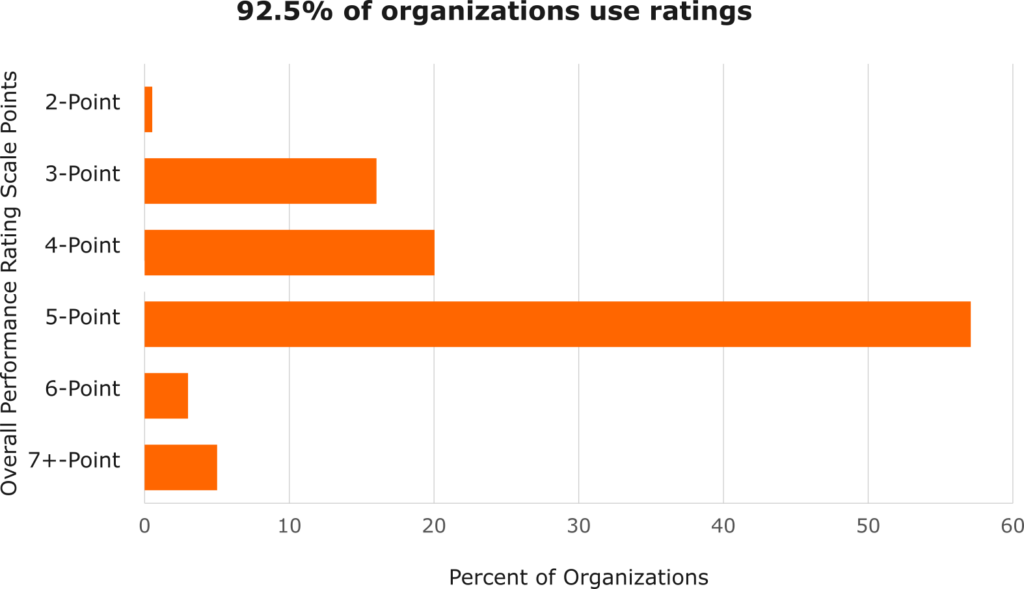
Our 2026 PM report shows that this era is over. Only 7.5% of companies have a no-ratings approach (mainly smaller companies), down from 10% in our 2023 study. In addition, 93% of companies have a formal review process, suggesting that eliminating reviews was a passing fad.
The good news amongst these failures is that we in HR hopefully learned to be more careful consumers of advice. The next time a consultant with no experience in HR or performance management writes an article in Harvard Business Review telling us how to do performance management, we’ll ask them tougher questions. When we’re told that we should stop using performance ratings because some people don’t like being rated, we’ll ask what the purpose and benefits are of assigning ratings.
Conventional Design Choices Now Dominate
While many organizations considered radical changes to their performance management approach during that period, today the vast majority have made very conventional design choices. A few key examples:
- Annual or biannual reviews: 92% of companies have annual or bi-annual performance reviews. Quarterly, more frequent or on-going reviews proposed by some companies during the “fad” years are used by just 5% of companies.
- Performance/behavior balance: The average company weights performance at 67% and behaviors at 33% in reviews. That’s not necessarily a benchmark you should pursue, merely a very traditional approach to balancing the “what” and “how” in a review. Many companies tell us that they have a 50/50 balance of these elements, but when we dig deeper it’s clear that performance is the dominant element rewarded.
- Typical scale choices: 3, 4 or 5-point scales constitute 93% of what companies use. We’ve worked with companies who sought out innovative ways to approach performance assessment. They all realized that evaluating performance using these typical scales is a simple and logical approach.
Those conventional choices are reassuring. HR leaders are realizing that it’s not novel or creative elements in performance management that drive performance at work. So how do we drive the quarterly and annual performance your CEO wants?
Do These 5 Things To Elevate Performance
There’s a clear path for us in HR to elevate our organization’s performance. We recommend our top few actions below. Some may feel familiar but not yet properly executed, and others may be new to you.
1. Make performance management strategy execution: This is not a tag line – it’s an operational imperative. Performance management should deconstruct and ensure execution of strategy layer by layer in the organization, getting the right goals to the right roles.
Where to start? Meet with your head of strategy if your organization has one and, if not, with whoever leads the strategy process. Tell them that you want to make sure performance management is a tool that ensures successful strategy execution. See if they’re interested in discussing this more (Note: they will be).
The secret connecting point between strategy and performance management? An effective goal cascade. Less than 1/3 of organizations require a goal cascade today. Voluntary doesn’t work: A mandatory, structured, planned and flawlessly executed cascade can help make performance management into strategy execution.
2. Reduce goals to a few: We know you’re tired of hearing this message from us, but we won’t stop. Set no more than three big goals related to the business (or functional) strategy to ensure a focus on what matters most. We describe how to do this in our article The Secret to Setting Great Goals and the fundamentals are simple.
Your role in HR is to force a reduction in the number of goals by teaching leaders about great goals. They need to make those goals big outcomes that matter; not day job activities. Teach employees how to write goals so we know what they’ll do, why it matters and how we’ll measure their success (we suggest our SIMple goal setting framework described in the article above).
3. Deliver frequent, transparent coaching: 55% of companies say managers should have 3 or more performance coaching conversations during the year but just 25% of companies say that actually happens. And, in 2/3’rds of those companies, two or fewer conversations take place.
Coaching and feedback (often) keeps performance and behaviors strong.
Let’s radically simplify this process so no manager has an excuse not to have these conversations. Our 2+2 methodology ensures feedback on what matters most and “feedforward” guidance for every single employee. I model how to do that here.
It may help to remind ourselves that the goal is not to make people managers perfect at giving feedback or coaching for performance. Instead, we want every manager to, at a minimum, transparently tell each team member on a quarterly basis how they can elevate their performance or behaviors. Create a process and accountability that ensures that.
4. Enforce manager accountability to drive performance: It’s the single largest missing element in every performance process we see. Managers rarely have any hard accountability for numbers 2 & 3 above. For goal setting, we advise manager-of-manager (2 level up) review of all goals and HRBP reviewing and coaching of goals for the top two levels they support. More suggestions and a process for identifying the best type of accountability can be found in our article The Accountability Ladder.
I experience surprising resistance when I make that last suggestion, but HRBPs should be goal setting experts. They should know their business, know their talent and know great goal setting. Their job should be to ensure great goals are set since great goals increase performance. They should love reviewing and improving goals.
5. Craft your high performer experience: Why should anyone be a high performer in your company if it’s not worth being a high performer? They’re contributing a lot – what are they getting in return? What’s the “deal” you’re offering them?
We find that few organizations have thought through this question and it’s a key reason that too high a percentage of individuals are typically selected as high potentials. Their manager only sees one “prize” to give them in your company – calling them a High Potential.
Think through and codify the investment you’ll make in your high performers and all your talent segments. Our article A Prize in Every Box can guide your thinking and provides a methodology to differentiate your investment.
Your CEO wants higher company performance. It’s the #1 item on their mind. Proposing that HR directly help deliver that outcome scares or turns off too many HR leaders. Think, however, about what a tremendous accomplishment that would be for your HR department. Not that you rolled out a new process, delivered a new program or paid for a new benefit, but that you actually improved the performance of your company.
But Do You Care?
Here’s the larger challenge. The paragraph above doesn’t describe a (not even the) primary motivation at work for many in HR. We know that from data that we’ve gathered for years in our Global HR Census research. In our 2026 research, just over half of respondents (59%) say that helping their company to be financially successful is a primary reason they are in HR. That number falls to less than 50% two levels below the CHRO.
If we’re passionately interested in our organization’s financial success (for those in for-profit companies), others will see that in our knowledge, our goals and our attitude towards the business. They’ll see just as clearly if we only love our function.
Our profession can easily regress back to the “should they be at the table” debate if HR presents itself as seeing business success as secondary to other pursuits.
The good news is that – if we care about business success – the five actions described above are guaranteed to make your CEO smile by elevating performance.
Where Are We With Potential?
The CEO’s second concern is whether the talent quality and depth exists to execute the strategy. We’ll capture this broad concern under the heading “potential” which includes the ability to accurately identify potential, critical roles, and the discipline to produce high quality talent. We’ll share the status of those areas and our advice on how to best execute each one.
What We Know About Potential
As we remind every client when we start a conversation on potential – potential is a combination of the individual and the situation. Both business leaders and far too many HR leaders obsessively analyze whether an individual has potential, ignoring that individual factors predict at best 50% to 60% of why someone succeeds at work. Part of the remainder is how they fit with their organization.
Our 2025 Potential Report found that just 38% of companies often or always consider a leader’s fit with the organization strategy when they assess potential. That may be one reason why companies say they’re just 44% accurate, on average, in predicting actual potential.
On the individual side, our analysis of the many consulting and academic models on potential shows consistent findings about high potentials demonstrated capabilities. including :
- Cognitive Power: They analyze complexity, generate insights and make sound judgments more quickly and more accurately than others.
- Learning Velocity: They learn quickly, evolve their positions quickly when new information surfaces and can apply learning effectively in new situations.
- Drive for Achievement: They show unyielding energy, focus and persistence to turn ideas into results – both personally and professionally.
- Influence: They create power and achievements by convincing others – upward, laterally and downwards – to align to their proposals and points of view.
- Action under Uncertainty: They feel comfortable in ambiguous or quickly changing environments, can understand key decision criteria and will take appropriate risks to achieve results.
The past decades of research on potential consistently show these results, grouped and expressed in slightly different language by different consulting firms. So, while the complete formula for individual potential isn’t known, it’s very likely that these factors explain a significant portion of it.
The research (one recent example) also reminds us that these factors work together to predict potential, so they should be assessed holistically. It also suggests that some factors more accurately differentiate potential earlier in career (1, 2 & 3), while others (4 & 5) emerge over time and are better predictors after ones’ early career phase.
The good news on measuring potential is that our research found a significant percentage of companies use a consulting firm model or a custom model that incorporates many of these factors. The bad news is that only 36% of companies believe their “potential assessment methodology works well today.”
What We Know About Producing High Potential Talent
The research above shows that organizations use the right factors to predict potential but aren’t satisfied with their results. That suggests a problem with the execution of the process, not the potential model. Execution looms as an even larger issue when we look at how effectively organizations develop high potential talent.
We know from polling thousands of Talent Management Institute participants over 16 years that there’s a significant gap between their organization’s ability to run a talent review and their ability to translate those results into a developed employee. We cited above the abysmal statistics about how many high potential employees (37%) have a quality written development plan.
A few other relevant statistics to consider: More than half (52%) of organizations do not differentiate the compensation of high potential talent. Only 39% communicate in some way to high potentials that they have potential.
As in other areas of talent management, adding managerial accountability can make a significant difference to results. In organizations where “People leaders have a specific talent development goal in performance management,” 49% of high potentials have a development plan – nearly 50% more than when there is no accountability. When there is no managerial accountability for development, only 23% of high potentials have a development plan.
Here’s the essential statistic: Only 36% of companies believe their potential process is effective in predicting potential. We’d suggest that statistic represents some inaccurate selection activities but far more unactioned development of people who truly do have upward potential.
What We Know About Critical Roles and “Talent-to-Value”
Our 2025 Critical Roles Report offered positive findings in that 86% of respondents said their company identifies critical roles. Their selection criteria was often, but not always, sound and included factors like impact on revenue, operations or risk.
That strong start quickly slowed down when just 57% of organizations said they ensure that individuals in critical roles are high performers or high potentials. Only a quarter of companies hold leaders accountable for critical role development or ensure those in the role have a high quality development plan.
Most telling, only 50% of respondents said that they ensure there’s a “ready now” successor for each critical role. That could be because only 28% said that those who manage critical roles are accountable to ensure leaders have a development plan.
Related to, but Different From, Critical Roles Is The “Talent to Value” Approach.
The term “talent to value” was branded by McKinsey and is now offered with various levels of rigor by numerous consulting firms. The key principles of talent to value processes include that talent is not equally valuable everywhere in a company and that a small number of roles drive disproportionate value. That means that if there’s not top talent in a critical role, you’re losing potential value for your company.
A talent to value process should differ from a critical roles process in that it starts with a value mapping exercise that determines how much value different parts of your business add. You then identify which roles have the greatest impact on those value driving areas. If you don’t conduct the organizational mapping exercise and the role identification, you’re not doing talent to value – just selecting critical roles.
While companies are paying consulting firms millions for talent to value exercises, more precise mapping of critical roles doesn’t solve the execution problem (development plans, managerial accountability, ready now requirements) that plague most companies.
Do These 6 Things to Better Select and Realize Potential
1. Take a Talent Production Line Approach: High quality talent is produced the same way as any other valuable product – with care, discipline and planning. The Talent Production Line approach we introduced 15 years ago is a helpful diagnostic to understand where your company can improve its talent-building.
Assess your talent-building process for one key role against the framework. Can you:
- Succinctly describe the few differentiating capabilities of high performers in the role? Do you know what you’re trying to build?
- Accurately predict which leaders can move “far and fast” through that role and others? Are you accurate in selecting for potential?
- Develop high performing leaders for that specific role in a disciplined and repeatable way? Can you produce talent at scale to the specifications you need?
- Ensure those leaders get to the roles you’ve developed them for? Are there any obstacles to get the talent to the places or roles you want it?
Too many companies fail to develop the potential they assess because they lack a disciplined approach to produce talent.
2. Conduct a clear-eyed critical role exercise: If you want to get development right, let’s start with your most critical roles. We discuss our methodology in more detail in our Critical Roles Report, but in short these are roles with meaningful and relatively immediate influence on revenue, operations or risk. The quality of the individual in the role is strongly correlated to the value produced in the role.
What’s a common mistake to avoid? Ask every function and business unit leader to give you a list of their critical roles. (Hint: Many staff groups may have no critical roles because they don’t have roles that meet the criteria above.)
3. Establish a precise, science-based potential model: There is precise enough science on the individual factors that predict potential that we can do better than broad terms like “aspiration” or “agility.” What are the specific behaviors and capabilities you need to see in an individual to evaluate their potential? (Hint: Upward movement over time [i.e. 1 level in 2 years] is a helpful way to chart potential but is not a definition of potential).
I list proven factors earlier in this article and a Claude search for “scientifically proven factors that predict upward potential in a large, complex organization” will hopefully produce a similar list.
Avoid “false precision” in your assessment. Leaders are either well-placed in their current role, can move upwards a little soon or move upwards a lot soon based on your potential assessment. More than three slices is too many.
Also, numerical ratings of a list of items or questions, or summarizing potential assessments into an average score, offers the appearance of accuracy where none exists. Humans cannot be measured with that degree of precision, and especially not through subjective processes.
4. Train HRBPs and Talent leaders in how to conduct talent reviews. Most HRBPs and talent leaders were never taught how to conduct a high quality talent review. They learned on-the-job with likely no reference for what “great” looked like. As we teach at the Talent Management Institute, the HRBP should be brilliant at both facilitating a fact-based discussion and in ensuring the production of that talent after the assessment.
Provide them with training in how to facilitate a high-quality review – fact-based, honest, accurate and development-focused. Be sure they understand that their role is talent production – not facilitating a meeting. This includes knowing the talent so you can present an independent point of view in the meeting and following up with leaders to ensure that high quality development plans are created and executed.
5. Tell Your High Potentials That They Have Potential. We’ve heard your reasons not to tell high potentials that they have potential – they might get big egos, they might get unrealistic expectations, or those without upward potential might be upset. We empathize with you and we have one thing to say – please reconsider.
You need to tell your best talent that they are your best talent and how you plan to invest in them. You don’t need to use the words “high” or “potential”, but at the end of the conversation they should know you’re making a sizeable investment in their future and feel a huge sense of responsibility for their ongoing performance and behavior.
Those “don’t tell” excuses can easily be overcome. What should concern you is what will happen if you don’t tell. You know who your high potentials are and your competitors know who they are. Your competitor is going to be thrilled if you make it this easy to steal away your best talent.
6. Accountability For Ready Now’s For Select Succession Roles: Not every role needs a “ready now” successor, but you should know the ones that do and hold that position’s manager accountable for producing one. Our definition of a “ready now” is a person who can be promoted into the role within 6 months and perform at a level that you’d stake your bonus on.
This means that lateral “ready now’s” should be looked at with suspicion. People moving left or right on the organization chart are blocking upward movement for others. Are you making the best choice or the easiest?
The “bonus” line above ensures that your leaders aren’t filling in succession boxes only because HR asked them to. We’ve all seen succession charts that are pure fantasy. This is too serious of an endeavor for game playing or managerial laziness.
Making Your CEO (and best employees) Happy
Your CEO cares about two things – performance and potential. We in HR have incredible power to help them achieve those two things.
We know how to help them deliver this quarter and this year: Set big, cascaded goals, deliver frequent coaching and hold leaders consequentially accountability for both.
We know how to ensure they have the right talent to execute the strategy: Identify your critical roles, use a simple and science-based potential model, facilitate fact-based talent reviews and use a talent production line to produce key talent.
It’s great news that we know how to support what matters most to the CEO. We now need to ensure that we in HR have the capability to do this, truly want to help the business do this and can influence the organization to accept and execute these essential practices.